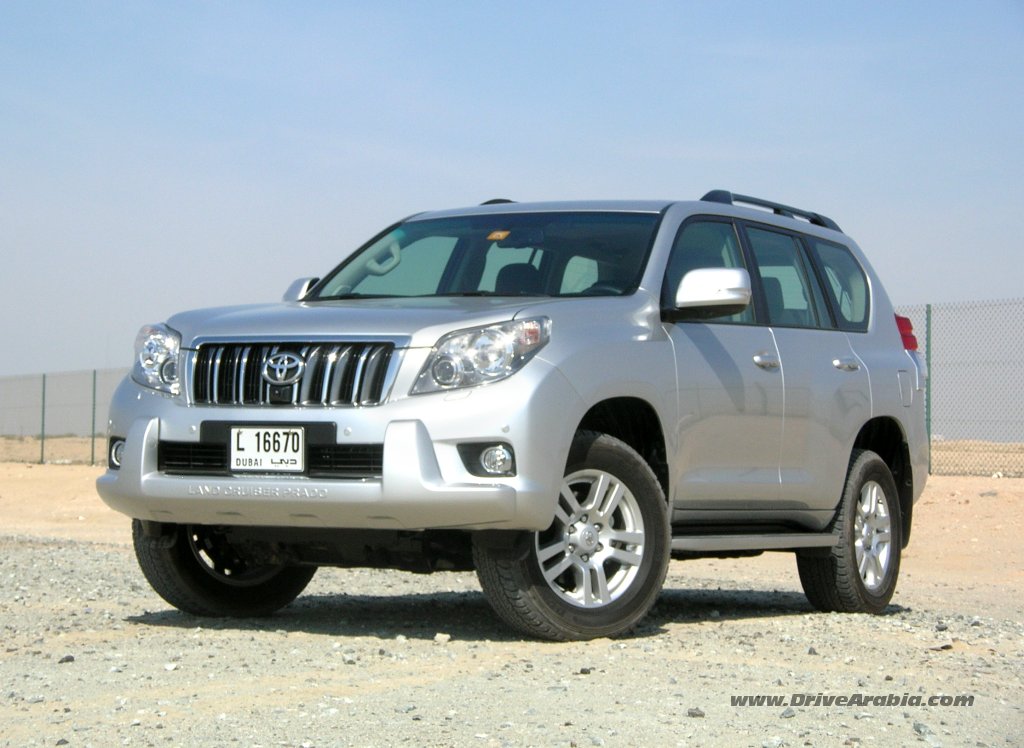
2010 Toyota Prado exclusive desert road test
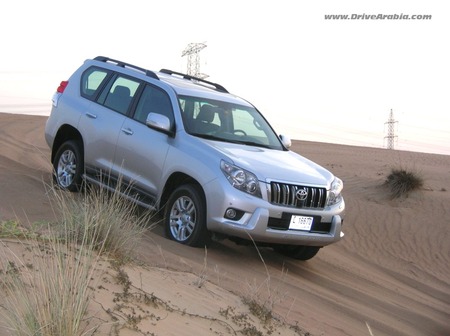
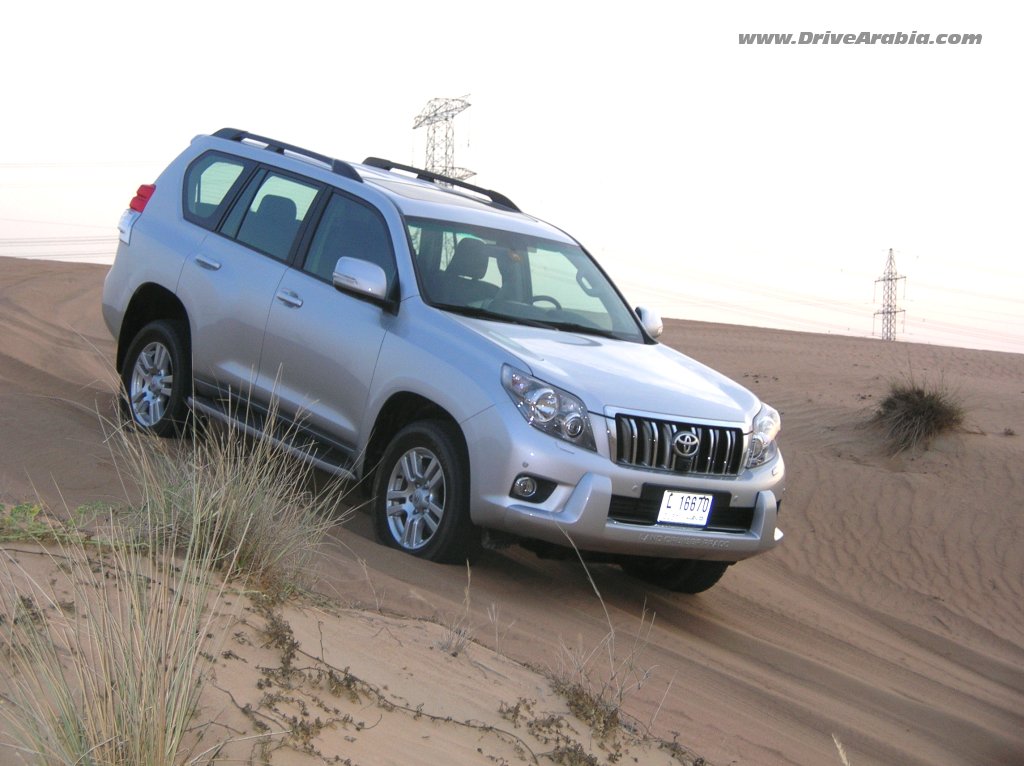
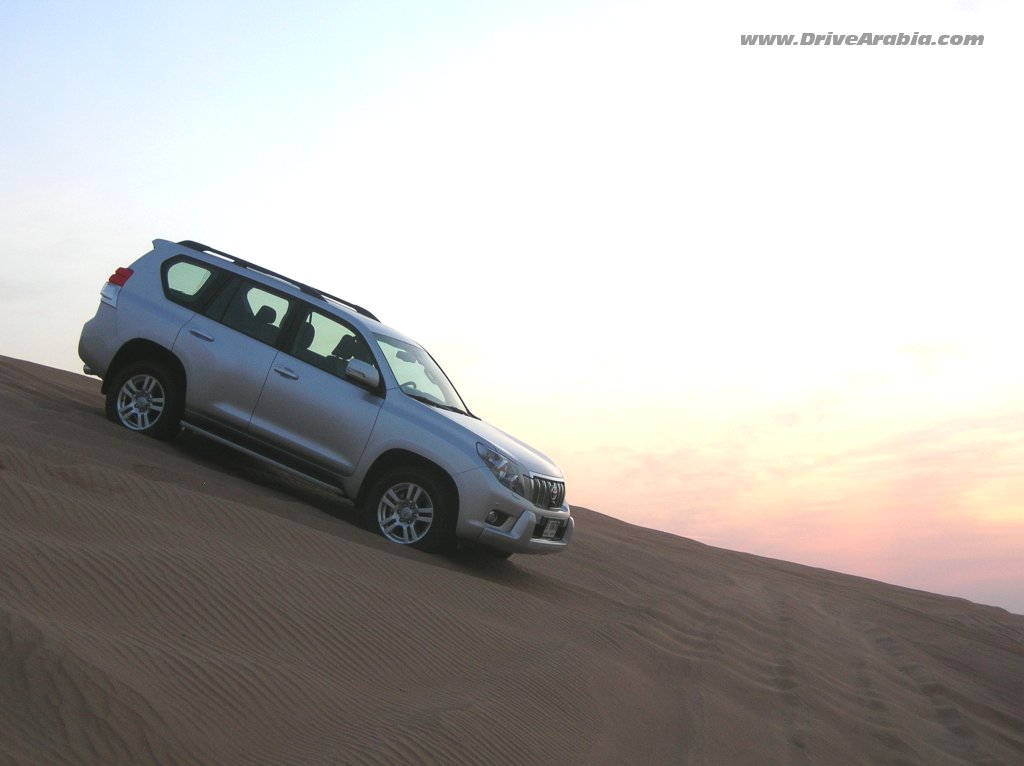
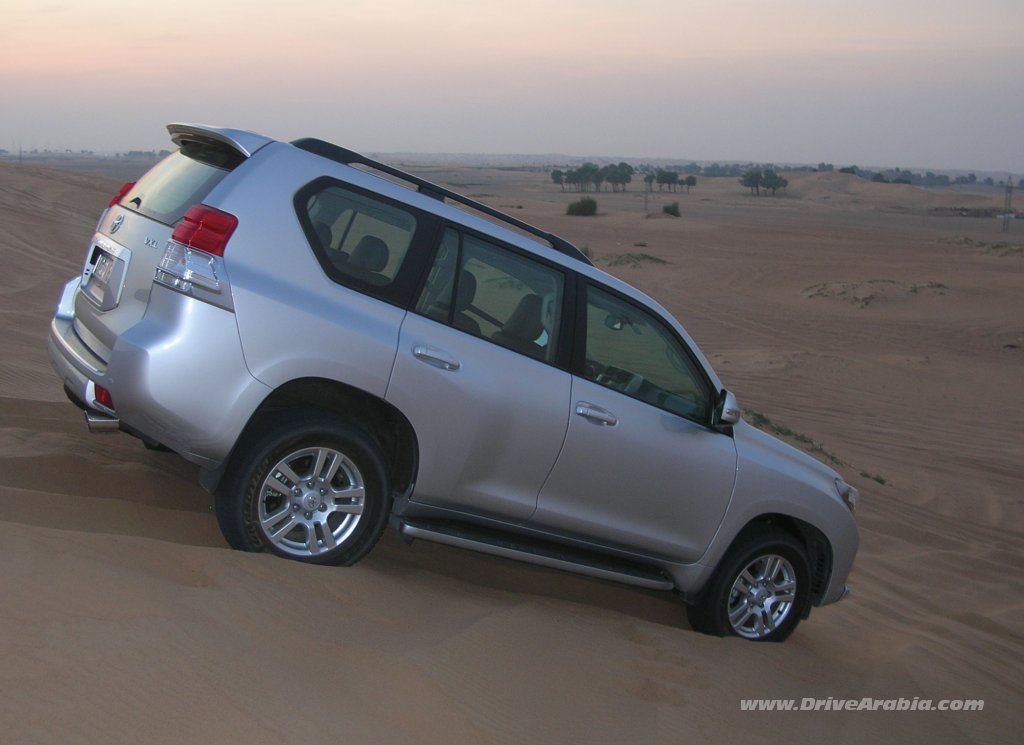
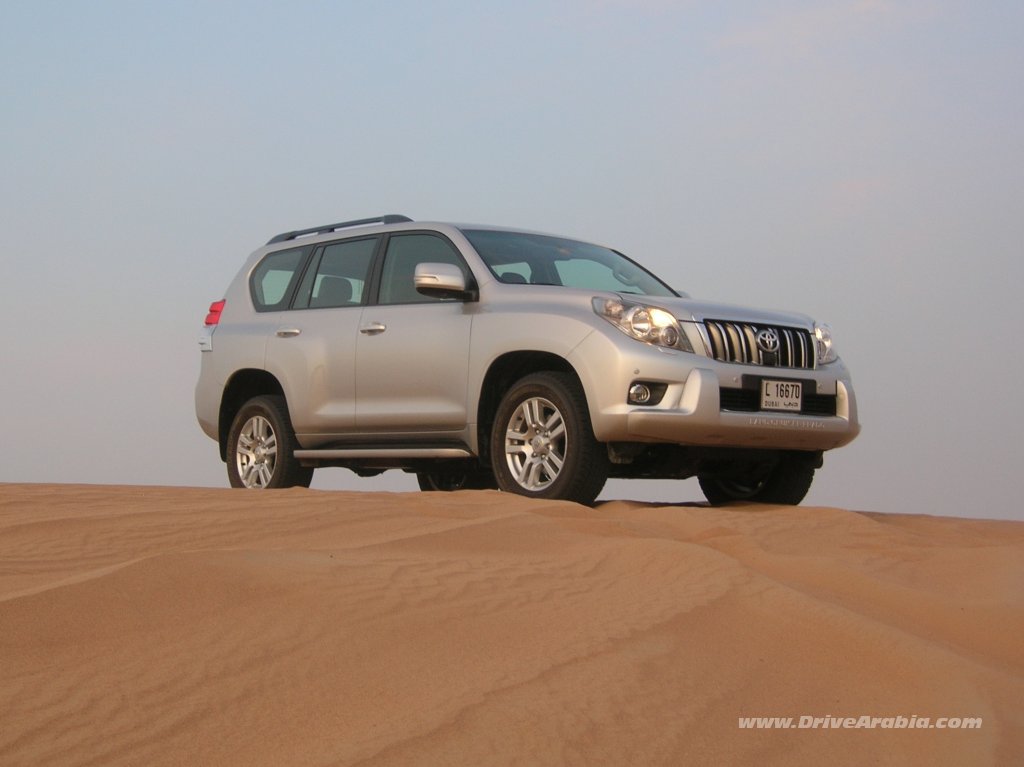
As far as we know, we are the first people to review the 2010 Toyota Land Cruiser Prado in the desert. Everyone else drove it “off-road” at the launch event, to which we were not invited, but that was a carefully-planned event with easy gravel jaunts anyway. We took our Prado VX-L tester on the same dunes used by desert safari outfits in Dubai.
Tagging along was my wannabe safari-driver friend, who suggested the location because he is tight with the local tour companies who use the Aweer trails regularly. In case we get stuck, there will always be someone a phone-call away to get us out, just like in our last sandy excursion.
However, the Prado is not some European crossover for yuppies, even though it is deceptively popular among the conservative set. We pulled out the tyre valves on the 18-inch wheels, deflated the 265/60-width rubbers, stuck the valves back on, and set off in our V6-powered camel.
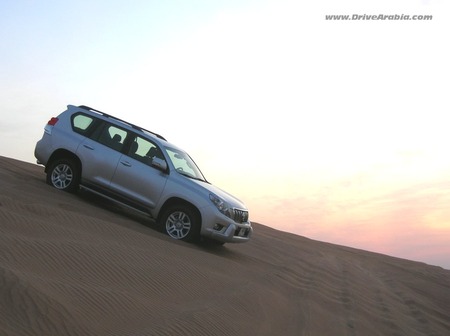
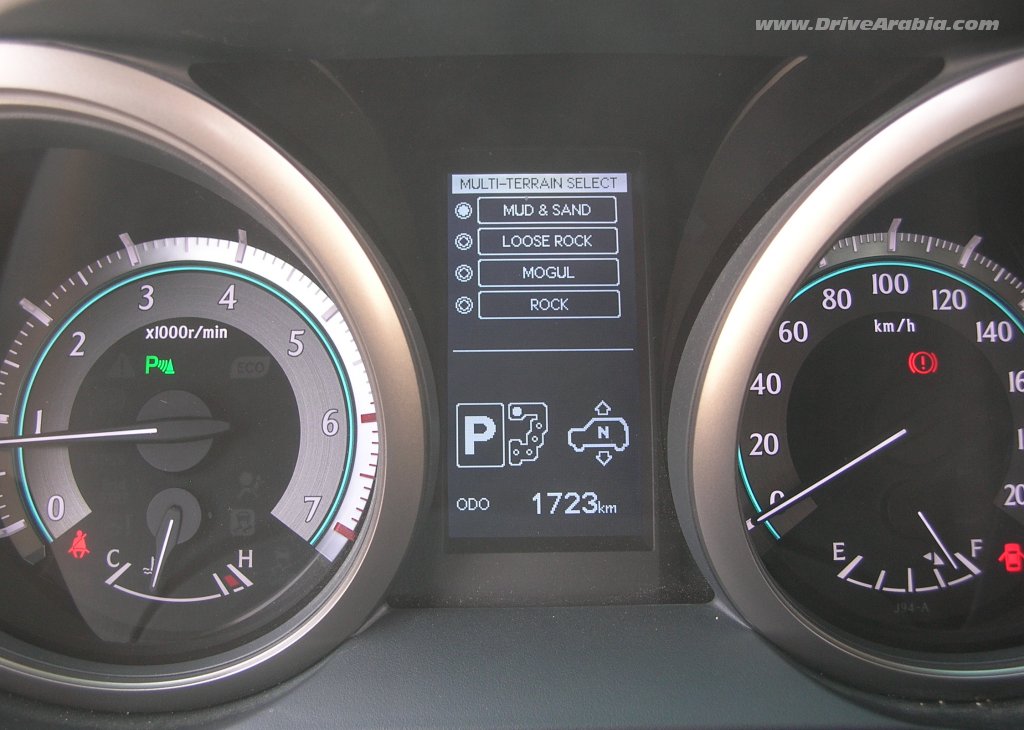
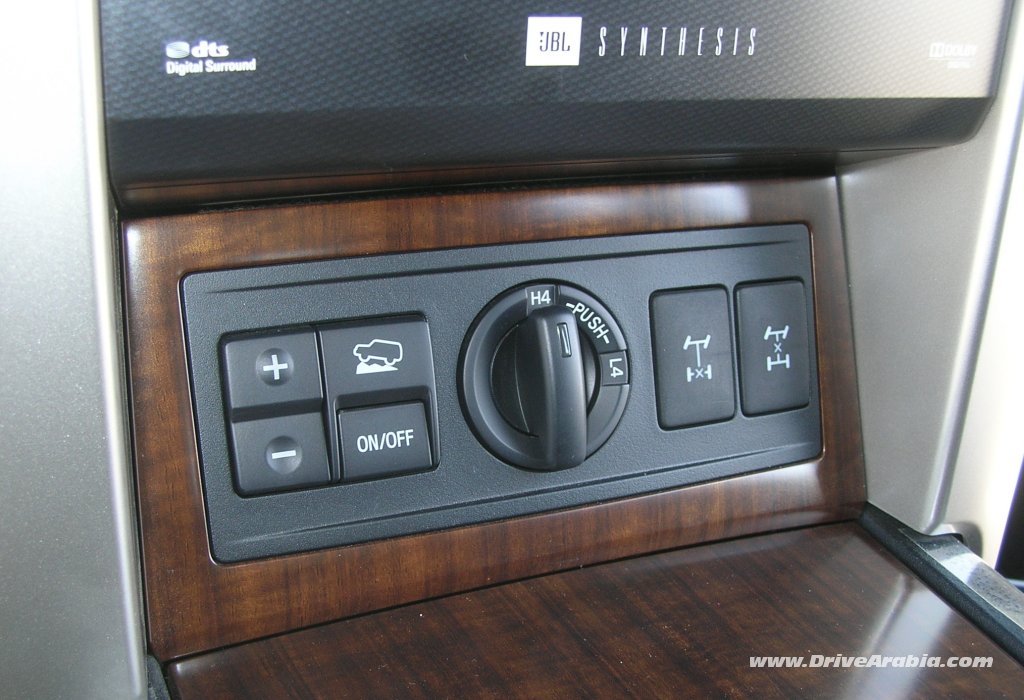
Our VX-L had the optional “multi-terrain” system, so we set it to “Mud & Sand” mode. We tried turning off the traction control, but once “multi-terrain” is activated, the traction control cannot be deactivated, and we were supposed to trust the computers to adjust the traction control to suit the sandy conditions. So we instead locked the centre differential.
It did not bog down at all. Even though I felt the engine did not have as much of a low-end kick as my V8 Jeep, it still had enough mid-range grunt to simply sail over the desert sand. It can climb moderate dunes using only partial throttle, and there was always enough ground clearance to not get beached on any peaks. Only later did we realise that in “mud and sand” mode, the air suspension automatically jacked up the ride height by a couple of inches, so we were towering over the ground.
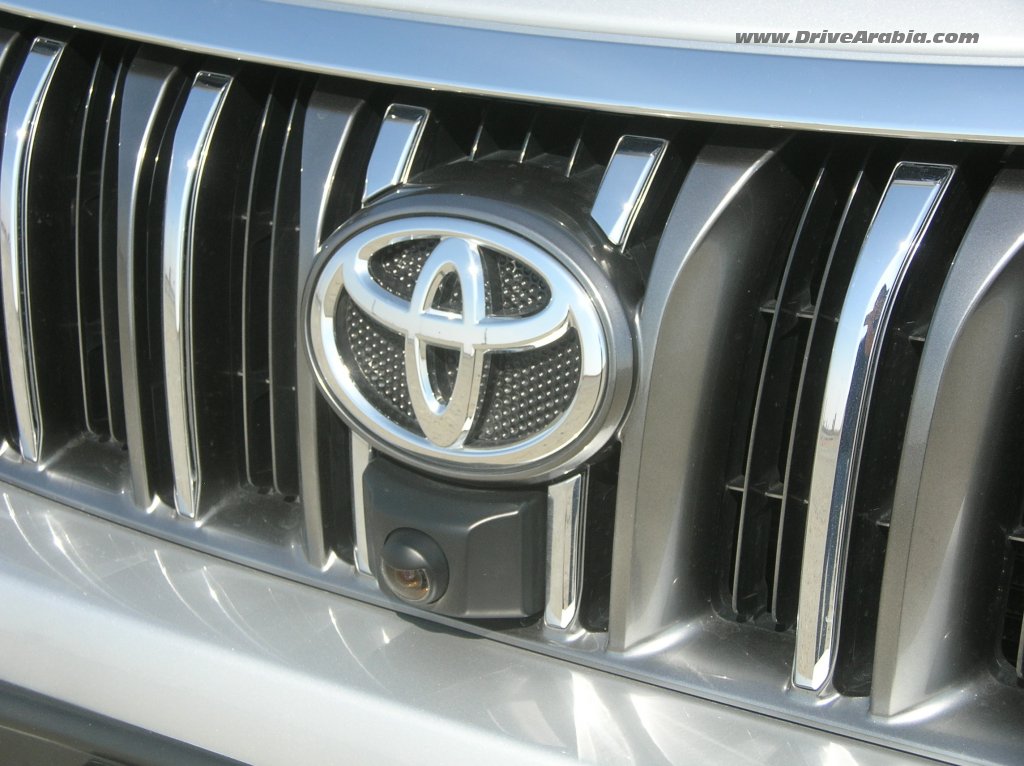
Some of the gimmicks are unnecessary though. The front camera was activated in “multi-terrain” mode, showing us which way the front wheels were headed, using lines on the screen. However, the camera only works at low speeds, and turned off as we started hurtling over the sand at relatively higher speeds, in true Arabian offroading style.
Also, the “multi-terrain” traction control occasionally made itself known while travelling down some dunes, hitting the brakes briefly once in a while, and annoying the crap out of all who drove it. Apparently it is supposed to do that, to reduce excessive wheelspin, although most offroaders prefer manual control of the brakes. Thankfully, it never went off long enough to bog down the vehicle.
We also tried the “crawl control” feature that takes the vehicle down a dune slowly without touching the brakes. It worked as advertised, with five speeds to choose from, instead of three in the larger Land Cruiser.
A few seasoned safari drivers and their boss checked out our Prado, and were easily wowed by the available techno-babble. They were especially impressed by the button-operated “lift kit” suspension, the electric-folding third row and the starter button. But they did not appreciate the traction control intruding on the downhill slopes, however brief. Most will probably prefer the lower-trim Prado models, without the “multi-terrain” gizmo. The safari boss knew what the “Mud & Sand,” “Loose Rock” and “Rock” options meant in the system, but joked whether the “mogul” option referred to Moghul Restaurant. Frankly, we didn’t know any better.
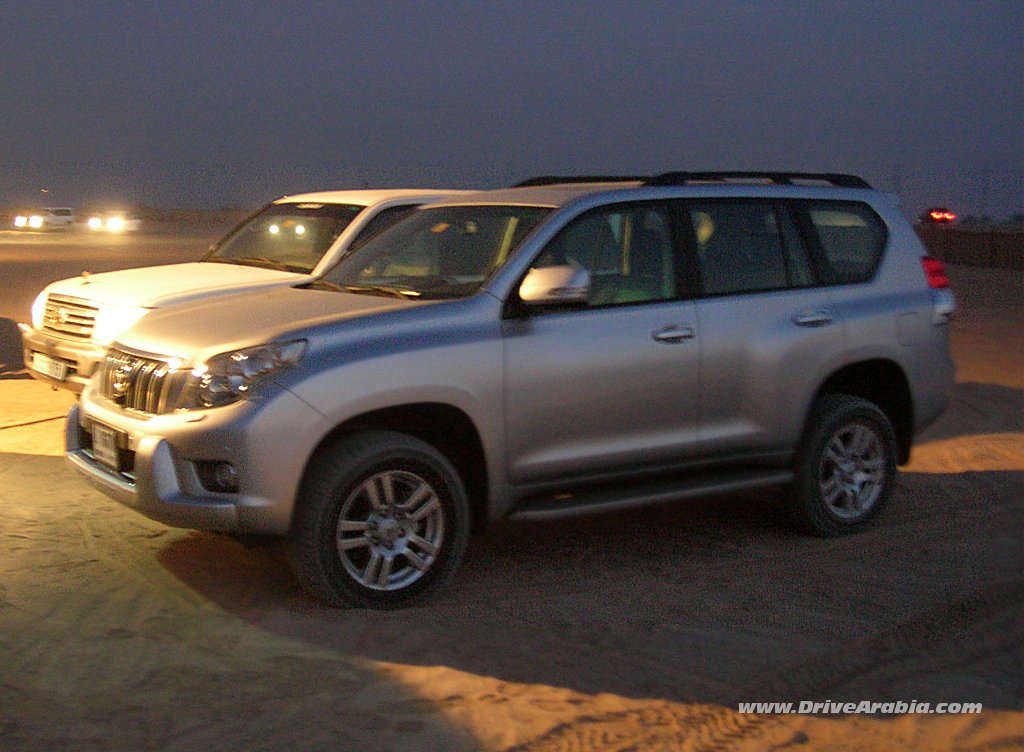
The day ended as the sun set and we sat down for a free dinner at the camp among foreign tourists. Interestingly, we never got to use the low-range gearing. It only comes in handy when stuck.

Comments
BJD (Boris)
the speedo looks sweet!
ROJ
Thats a generous dose of luxury in this car.. Nowonder why it got more expensive..
royer
Great…
aaamohamad
did you see dancers during dinner???
nice review..
shafiq
here’s a definition of MOGUL :
# a bump on a ski slope
# a member of the Muslim dynasty that ruled India until 1857
# baron: a very wealthy or powerful businessman; “an oil baron” “Tycoon”
# a restaurant in Dubai, U.A.E.
Mashfique Hussain Chowdhury
^ That clears up a few things.
The camp and whatever comes in it are always free for us.
hari
Hi Mash,
Could you please give some review about Prado TX or TXL as most of them buying these models.
We seek some on-road review as well
thanks
hari
cayaNIde
What is this frog doing in desert…
BJD (Boris)
well, desert is kinda home for this frog…
cayaNIde
it is destroying our environment lOOK what happened to LC’s they even destroyed the safari camps in aweer lOOks better in pounds.
Faisal
The Prado looks better in the shots posted by you then the shots Toyota had…
ROJ
I admit… That it looks better than the previous model… But the car still is not much of a looker… Most people will also settle for the entry level model, I dont find any neeed for a Range Rover offroading system in a Prado… Well yeah its cool but not necessary hence an unwanted expense… Say will they release a 2door model?
Vivek
^^it looks better than previous model???? no ways!
BJD (Boris)
yea the previous model looks better.
Mashfique Hussain Chowdhury
Haha! I made the Prado look good with my bro-fessional fotography.
Be005
I guess look wise the current model is a disaster, the earlier version had better look. This one look like like a fake landcruiser almost like the diffrence between a nokia phone and the chineese remake of it. Had expected a much better version for a most awaited model from toyota,totally disappointing 🙁
ibin
Sorry..
but I have to say it..
I really, sincerely & utterly, to a point where I would call up toyota and tell them that, ‘God-has-most-definitely-abandoned-your-lot-with-the-slightest-possibility-of-any-creativity’, hate PRADOS..
even though I have owned one..
for the last 4 and a half years..
Feroz
Well thats all abt the looks
if u r really into driving thn the looks doesnt mater,
all it counts is the driving pleasure and power
Mash, we came to know tht this beauty was a beast in desert, wat abt it on the road,
how is it tuned on the roads, i heard frm a friend of mine frm AU, tht it is very much better n smooth on road than the previous 2009models,
can u tell us plz
spyke
Hahaa nice one,,so why’d u buy one??
BJD (Boris)
he probably got it when toyota was good.
ibin
Actually..
I bought one when the styling was completely new..
Then afterwards.. Like all the recent prados.. They all seemed to resemble one another.. In an inbred type of way..
Sorry if I’ve been too concentrated only on the exterior of the car..
But Honestly guys..
For a car that is ultimately a PRADO (And not a Gallardo)..
It is still very boring..
P.S.
Even is it is a splendid car off-road..
Feroz
Well,
for about a year i was waiting for this, but when it was launched, i was shocked by its over price, but thn the mid models came
here in saudia, the TXL model is better than the 2009 VX2 model , with cruise control and all the goodies and even much more than tht of 2009,
yes today finally my dream came true, i drove the TXL model – V6 4 litre engine, it is purely awsome, better power i felt than that of its previous one, yes surely it is 271HP folks,
and i felt tht it was smoother than the 2009 one, over all i was impressed with it, and justified the increase of the price,
as the 2009 Prado VX2 came at 132K, the TXL V6 is comming at 136, so after all 4 k increase is not that much, buy for those who want entry level into V6 then yes it is too much increase, as 2009 V6 VX1 was starting at 120K, and the v6 is starting at 136 automatic transmission,
Prado cannot be compared to a GALLARDO
Gallardo can go only fast, but is not a practical car which can be used daily,
but a PRADO is a superb piece of machine, which rocks on the rocks and shines in the city.
ROJ
Its a matter of time to get used to it.. Last prado was also considered ugly and took time to adjust to the new shape..
Afaq
eventually people will get used to of its ugliness. and will start accepting it……but still the first impression is UGLY though!!!
samdam
You know why I don’t like toyota because every new generation they release always has the same engine over an over.for e.g 2010 toyota prado has the same previous 4.0 v6,2.7 & 3.0 turbo diesel.
BJD (Boris)
true but they have really good engines, with torque at low revs (so I’ve heard). so they probably dont want to mess with something that is already good. But it can also be that they are too lazy to do anything to it.
hsn
Ugly exterior, odd interior, and engine as usual old engine transmission as usual very old gear with 4 or 5 transmission no sport, no tiptronics. it is just camel in desert
azz
so u know to drive in the desert?
Murf
ok, people! this article not about how ugly the vehicle! Its bout its great off-roading capabilities! From the looks of it, it passed with flying colours.
Akif A.
@hsn … Wrong!
Engine although still a 4.0l, is new and mated with a tiptronic type (sequential shift) gear system. A new adaptive variable suspension with a multi terrain selection, diff locks plus a lot of other off roading goodies all of which unfortunately comes with a fat price tag.
Exterior is also an improvement over the previous model.
perviz
ya xocu noviy toyota prado 2010.mne intres cena
hsn
to akif…
(sequential shift) gear system is semi- automatic transmission and not tiptronic, thats why toyota site not mentioning any thing regarding tiptronic or sportronic, go and read wikipedia for tiptronic my dear
to azz…
if you change your name…..may be
Akif A.
@hsn..
LOL.. c’mon buddy, i don’t need to check the wikipedia to know the difference.. which is why I’ve said tiptronic ‘TYPE’~ sequential shift.
Although both are different mechanisms, the application eventually is the same.
Are you suggesting that tiptronic isn’t a semi-auto transmission?? Then what is it?? >:o) .. do tell.. but without looking at wikipedia .. hehe .. which by the way does not always provide 100% reliable info.
hsn
to Akif,,
My friend….it seems you didnt try real tiptronic!!!! and btw reading is good especially for me normal car user 😉
Akif A.
@hsn
Hey Buddy, sorry.. didn’t mean to be rude or anything…
Driven vehicles with both versions of transmission…and you will not find the difference.
I agree… reading is good but i for one wouldn’t put my money on speculations from wikipedia >;o)
hsn
to akif..
No problem, and thanks for your valuable information.
Troy
Toyota, should kill their design team first and then themselves for approving the worst Prado design ever. Hell the first and second gen Prado looked way better. After seven whole years this is what the come up with crap!
Asim Mohteshim
Gents,
For those who are confused by different opinion on Prado 2010, let me share my experience in selecting a SUV in that class/range.
I have visted all the posible SUV’s showrooms and researched on specs and features and ROI with different SUV’s , and dicided on PRADO TXL.(V6).
I found it fullfilling city and offroad skills, and with luxury (at a price offcourse).
Price : Yes at bit higher side from where i expected it to be, but the car is also beyond what i expected from it.
Ford explorer,Mercury Mountainer, Nissan Pathfinder, Honda Pilot, GMC Yukon were my list of other cars in consideration, but after long study(5-6 m ) i had zero down Prado.
Only Pathfinder came close to it by having 270 hp , still Prado had 1 extra hp i.e 270 on V6 models.
Yukon was my first thing in mind , but i lost that love once i had a test drive and felt it is too light and very thin layer of body , not a strong car at all , but with great looks , a photogenic decor car.
not a true SUV .
My Reson:- I felt i was compromising on something in very car , except Prado. I was trying to convince my self for other cars for better price (no much difference) , but felt something missing or incomplete with every car, PRADO was the only car i felt complete with , i didnt had second thought about it and there was no car i wanted to trade againts Prado , so i made the diccisoin to Buy Prado TXL and i did it . (139k saudi riyals- including registrion)
I am waiting for the dealer to do the paper work and deliver it to me , which will be next week , but every day i am growing my admiration to Prado.
Advice: GO FOR IT , if you want power,ROI, resale, road respect, city & offroad drive, family SUV this is the car buddy.
🙂 🙂 🙂
Banas
this is one ugly rice burner
avi
TXL V6 4.0L IS AN EXCELLENT CHOICE FOR BETTER PERFORMANCE ,RELIABLE, SAFETY AND RESALE
Jammo
hello! am so impressed with all the feedbacks of this new prado! But am just wondering why on earth shld a dubai series with multi terrain system and crawl control does not come with the HAC and DAC? I do not normally go offroading so i would prefer to have the DAC and HAC option better! Is there any chance that i could install the option as add on? Thanks and more power!
Jammo
hi! btw am referring to the VXL variant. wat is the difference in the TXL model? Which is really better? spare wheel on the rear door or underneath?thanks again
Abdabu
i dont see much vxl models in ksa
Holy
kindly suggest on 2010 prado TXL V6 top range feedback in terms of performance, space, mileage, value for money
Jammo
hello! still haven’t received any feedbacks from the experts around here! Anybody can help re HAC and DAC options? How can i add it to my unit? VXL Dubai series thanks!
Prado Malawi
@Jammo Crawl Control replaces HAC and DAC, once selected it does the same thing, regulates throttle input and driving speed.
This is a fantastic vehicle, in terms of refinement and perceived quality, it is definitely better than the old model. Diesel engines are still at least 35% less powerful than the competition, which remains frustrating. Toyota’s 1KD-FTV 3.0 Litre D-4D engine has been around for ten years without any significant upgrades, that is ridiculous! Other than the underpowered engine, the ride is good, handling on road is on par with rivals while braking has been revised and improved. The addition of a rear diff-lock is a welcome one, as is the flat folding rear seats. Interior does look ugly, but is functional and luxurious with a great navigation and sound system.
I’m still happy with mine, Prado remains a great vehicle, even though it’s looks polarize opinions.
MAK
Dear All,
I am planning to buy TXL 2.7 4 cylinders Prado 2010. I have no concern to go off-road drives (like desert etc). I will use this Prado for Town and highways(long drives). Can someone please recommend to buy 2.7 4 cylinder Prado?
Whereas Hilux/pickup/fortuner has same engine as Prado 2.7 has.
Waiting for your prompt responses.
Rahul Jones
@ MAK: The 2.7 litre engine is really good. In terms of economy, maintenance and power I suggest that. I have driven vehicle with these like the Hiace and Hilux. They both perform well and even the economy is good. I think it is really a good choice if you look for economy. Performance is good but obviously can never be like the 4.0ltr version.
Johnny
I am really sorry but I didn’t like the looks of the car nor the drive! I test drove it and all the comfort I was supposed to get was not there. I ended up buying a Pajero full option and still saved some money. My 2 cents.
Prado Lover
I dont know about you guys, but this baby is one heck of a car…it looks awesome way much better then the previous one..and is a monster off road. I think for me the 4×4 that comes in first place is the new petrol 2010 but this baby comes in just right after.
sabitha sajan
so if all this power and luxury in available in the prado, why why would anybody buy a landcriuser!!!! (refering to my husband who like landcriusers rather than prados)
vivek
@Sabitha: Because, for only a few more bucks, one can get a Land Cruiser which is obviously much more powerfulere) (referring the V8 h, has much more space, has a way better image and gets much more respect and bettr off-road due to bettr low-end torque (once again referring to V8)..And in the popular laymans words which is what matters at the end of the day to all the automobile illiterates out here -> A LC is an LC and a Prado will always remain a Prado! LOL 😀 😀
masood
Very nice
Mitch
The most sold Prado’s in UAE are 9541 and 9531 models. It would be very helpful to do a test on this models since almost nobody is buying the one you reviewed. It too expensive and goes on a price range of a Land Cruiser V6.
Meanwhile prices have gone up again. People still buy them but they choose the cheaper models.
The 4.0 model(9531) without sunroof and leather costs now 161k dhs.
marc
the rediculous thing about the T-XL is that even the full option version comes without side airbags!!! wtf…!?!?!
they should come clean and some proper safety gear at prices of 161-170k..
Asad A.
AlFuttaim Toyota seems to be cutting costs everywhere .. 2010 or 2011 model onwards they even discontinued side airbags for the rear passengers … probably thought no one would care less
Asad A.
……..*they even discontinued side airbags for the rear passengers ON THE FJ CRUISER*….
marc
good observation, asad. and agree.
problem is, toyota is selling so well, they can do whatever they want and still sell plenty of vehicles!
i wouldnt be suprised if they only provide half a steering wheel for the 2013 versions, probably no one would bother anyways..
Pathfinder2002
Prado is really very expensive mid-sizer.I don’t know why it’s above 20,000AED also.
Pathfinder2002
I mean 200,000
Almansoory
this very bad i buy a patrol for me and landcruser for my child.
Adil Miohammed
Prado is one of best ever cars i have seen and almost 2 months back i bought one, i agree its a bit pricey but worth its price. I even checked with ford explorer, nissan pathfinder, jeep grand cherokee, honda pilot all these are just useless pieces of shit. Prado is just rocking and has more than what it deserves, its a monster with awesome comfort, style, specs, ride quality, power, handling and much more. It is just god compared to all the shit cars in its range such as pathfinder, pilot, grand cherokee, explorer. I’m proud as an owner of prado