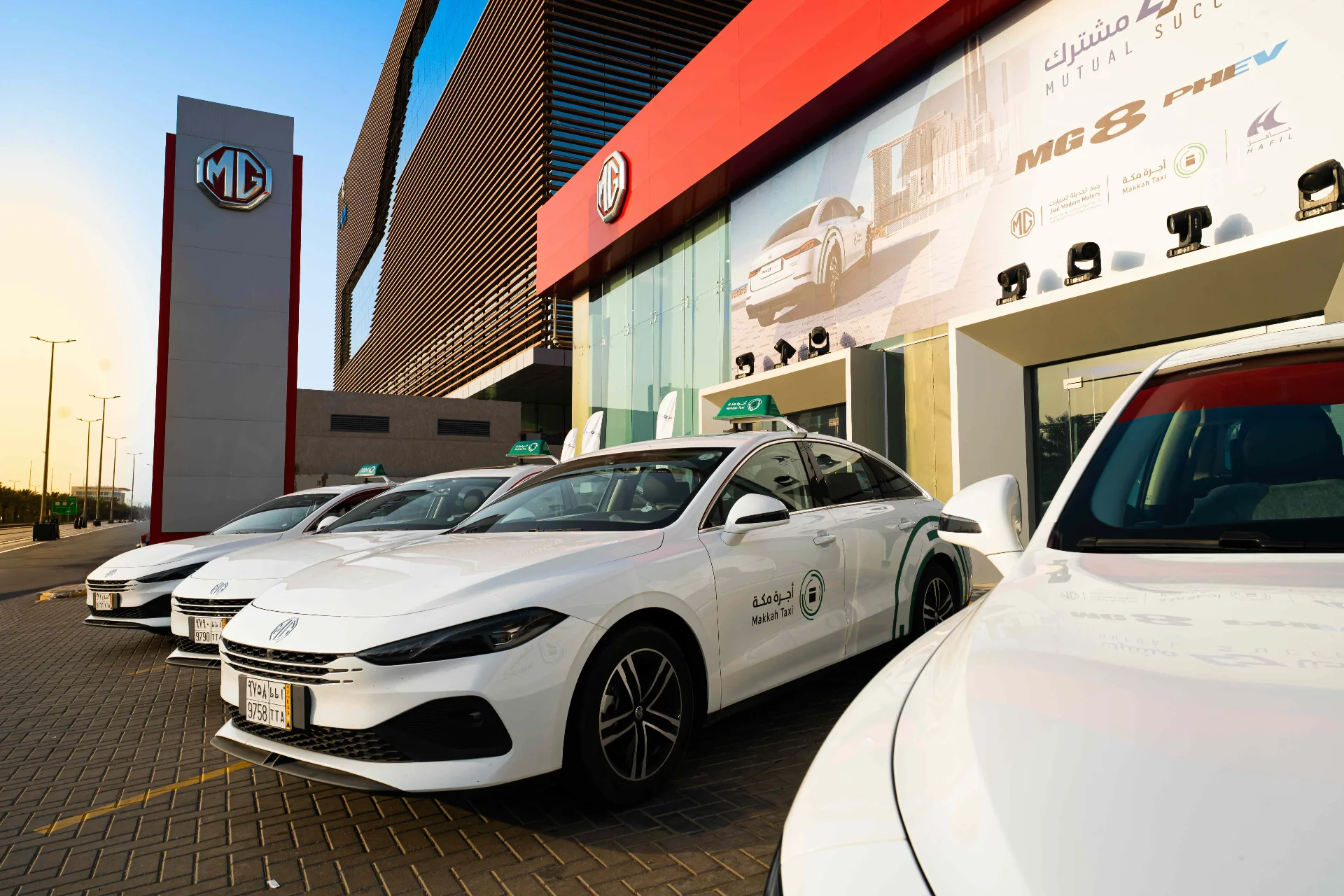
MG rolls out MG8 PHEV taxis in Saudi Arabia
MG Motor Middle East has taken a clear step toward expanding its electrified vehicle strategy in the region, with the rollout of MG8 plug-in hybrid taxis in Saudi Arabia. The move comes through a partnership between Jiad Modern Motors, MG’s official distributor in the Kingdom, and Hafil Transport Company.
MG8 PHEV enters Saudi taxi operations
The agreement targets Saudi Arabia’s growing public mobility sector, with the MG8 PHEV being deployed within the Makkah Taxi network. An initial batch of 55 vehicles is already being introduced, with a further 75 units scheduled to join next month, bringing the total fleet to 130 vehicles.
MG focuses on high-usage fleet deployment
This rollout is significant not just in terms of volume, but in positioning. Rather than focusing purely on retail electrification, MG is pushing into high-utilisation fleet operations — a segment that tests real-world durability, efficiency, and cost of ownership far more aggressively than private use.
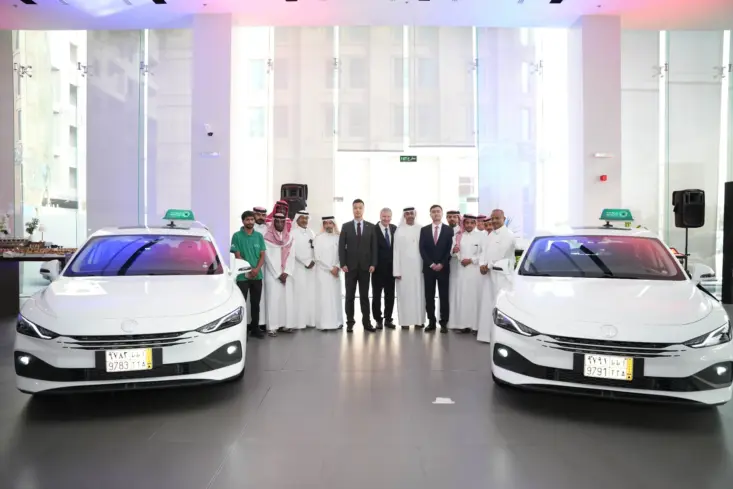
Hafil Transport, established in 1999, is one of Saudi Arabia’s key mobility operators, with a strong presence in public transport services across the Kingdom. Its adoption of plug-in hybrid taxis signals a shift in fleet priorities, where efficiency and long-term operating costs are becoming just as important as reliability.
MG8 PHEV built for long-range, continuous use
At the centre of this deployment is the MG8 PHEV, a large sedan designed to handle continuous usage cycles. MG claims a combined driving range of up to 1,655 km, a figure that highlights the practical advantage of plug-in hybrids in fleet applications.
Unlike full EVs, PHEVs remove range anxiety while still offering reduced fuel consumption and lower emissions, especially in stop-start urban conditions. From a fleet operator’s perspective, that balance matters. Charging infrastructure, downtime, and route predictability all influence adoption decisions.
Focus on passenger comfort and usability
The MG8 PHEV is also positioned as a premium offering within the taxi segment, featuring a spacious cabin and a technology-focused interior. While these elements are secondary to operational efficiency, they play a role in improving passenger comfort and overall ride quality — an increasingly important factor in competitive urban mobility services.
MG8 rollout aligns with Saudi mobility goals
This move aligns with broader developments in Saudi Arabia, where sustainability targets and mobility transformation are accelerating under Vision 2030 initiatives. Electrified public transport, including taxis and fleet vehicles, is expected to play a key role in reducing emissions across major cities.
For MG, the strategy is straightforward: prove its electrified technologies in demanding, real-world environments. Fleet deployment offers immediate scale, consistent usage data, and strong visibility — all of which help build credibility faster than retail adoption alone.
Potential for wider GCC expansion
Jacky Xu, Managing Director of MG Motor Middle East, highlighted this direction, noting that the brand’s NEV lineup — spanning hybrids, plug-in hybrids, BEVs and EREVs — is being positioned to match varying market needs across the region.
The MG8 PHEV taxi rollout serves as a practical case study of that approach. If the model performs well under high-mileage conditions in Saudi Arabia, it could open the door for similar deployments across other GCC markets.
With governments across the region gradually tightening efficiency standards and encouraging electrification, fleet operators are likely to become one of the biggest drivers of NEV adoption. MG’s latest move suggests it intends to be part of that shift early — and at scale.

Comments are closed. Please send an email if you have any feedback.